

Issue 04 · Monthly
What Is Your Forecast Accuracy Worth?
What buyers read in your forecast, and the five rules that make it reliable.
By J Chad Brown, CEO, CommEx Advisors.
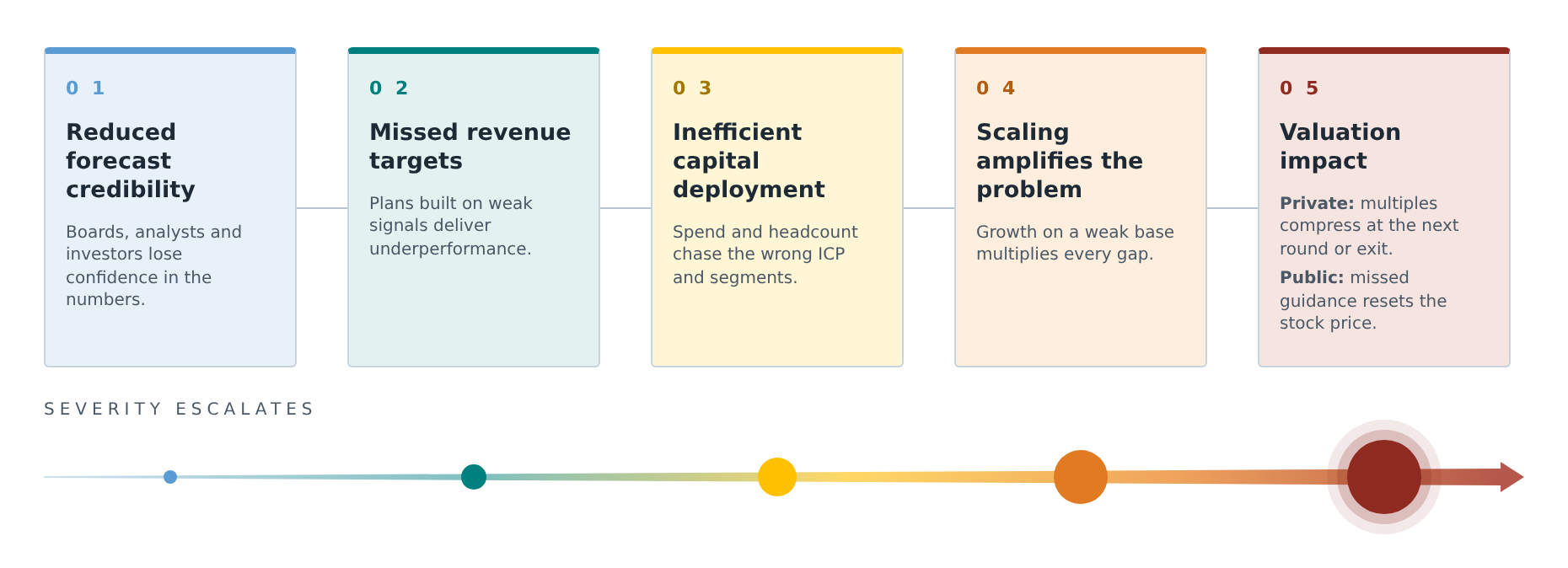
The best place to start a conversation about forecast accuracy is with forecast inaccuracy and how it compounds over time. I believe most organizational challenges stem from an unreliable forecast and represent a fundamental breakdown of core commercial discipline. Often, there's no clear structure or process, and nobody requests evidence before a deal enters the forecast. Deals are advanced without evidence to meet the stage gate exit criteria, and no one asks for evidence behind the assumptions. By the time you miss the forecast, you have already hired to reach that number, bought inventory based on projected demand, set cash aside in reserve, and may have made major commitments such as equipment, facilities, or additional R&D spend. The ripple effect ultimately reaches the company's value, whether it is public or private.
Forecast accuracy is a lagging indicator because the problem usually starts two to three quarters before the miss. The early signs appear in the funnel: fewer new opportunities, longer sales cycles, more slipped and re-quoted deals, and pipeline coverage falling below what you need to hit plan. Those funnel signals are your canary in the coal mine.
How much is forecast accuracy worth?
Public companies show it most clearly, because the market prices a missed forecast the same day:
- In July 2019, Illumina said that population genomics deals it expected to close in late June had not closed, and it cut its revenue growth forecast for the year from 13% to 14% to about 6%. Its shares fell more than 16% after hours.
- In October 2024, 10x Genomics reported preliminary third-quarter revenue of about $151.7 million, below analysts' expectations, and said changes to its commercial organization had been more disruptive than expected. Its shares fell about 25% the next day.
- Neither miss was about the science or the market. In one case, deals slipped out of the quarter, and in the other, a commercial reorganization went worse than planned. A commercial reorganization isn't just a change in structure, because the bigger effect comes from the lack of process during the transition.
- A private company has no share price, but a buyer applies the same logic, and any reduction it makes to a forecast it doesn't trust comes straight off the company's value.
- It can be done in our sector. From 2018 to 2021, NanoString's product and service revenue averaged 99.4% of the midpoint of its initial annual guidance.
What do buyers look at to judge a forecast?
The essay walks through the five data points a diligence team reviews to assess a forecast, including forecast vs. actual over eight quarters, slipped deals, how pipeline coverage was built, whether management's forecast matches the CRM, and how many versions of the forecast exist. It explains why the earliest warning signs appear in the pipeline two to three quarters before revenue falls, giving an engaged owner who knows what to look for time to act before it’s too late. It also describes what an unreliable forecast looks like from the inside, including the discounting heroics used to save a quarter: extra discounts, terms, and no-charge add-ons that lower revenue and margins and bring in customers who don't fit the ICP.
How early does forecast risk show up?
The best way to see a miss coming is to build the forecast backward from the revenue plan, through the pipeline, the demand generation that feeds it, and the sales team that works it. The chart below illustrates how that works.
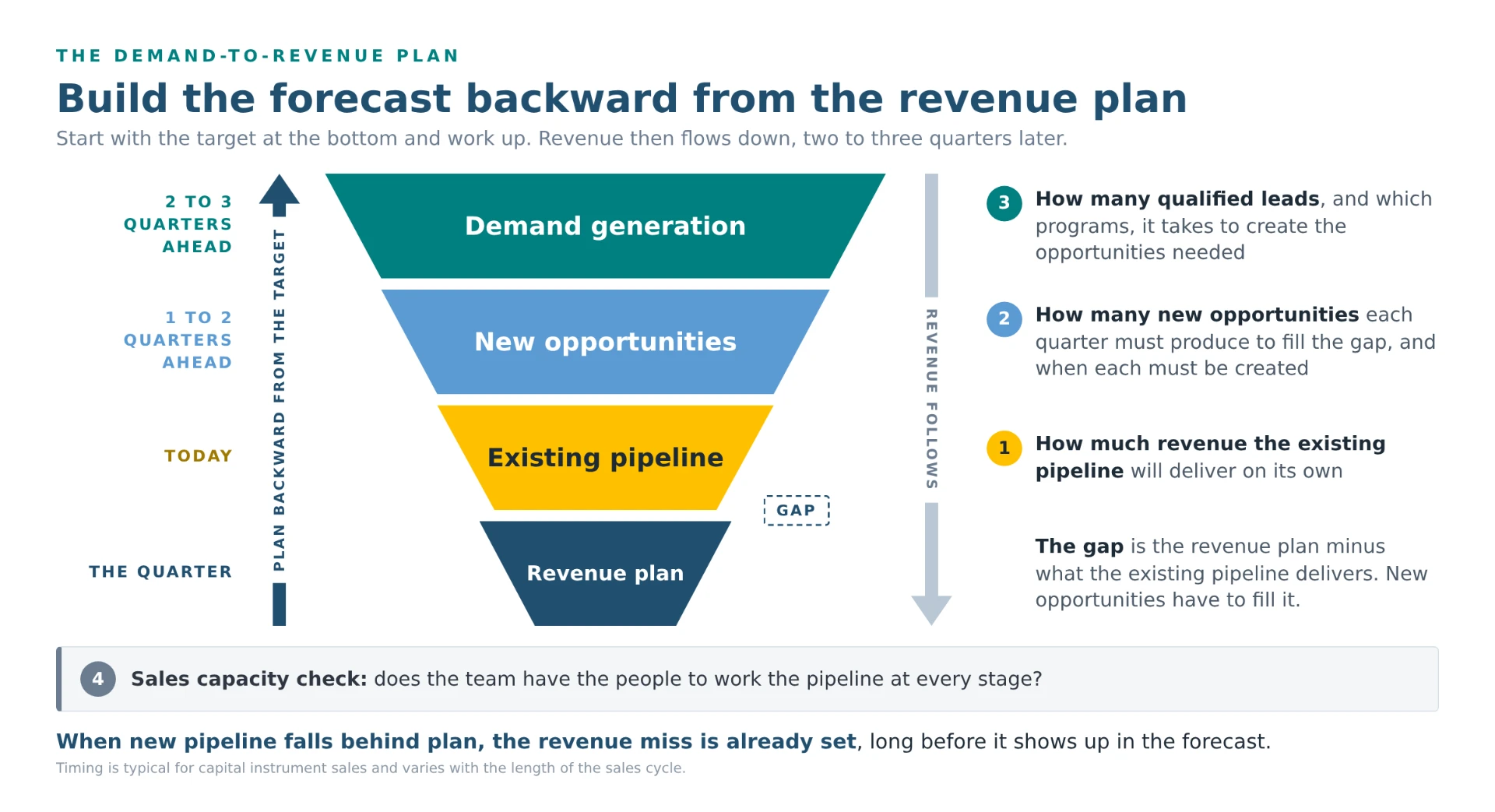
Read it from the bottom up. Start with the revenue plan for the quarter and subtract what the existing pipeline will deliver on its own. The difference is the gap, and new opportunities must fill it, which tells you how many each quarter must produce and when each one must be created. Working up again shows how many qualified leads and which demand generation programs are needed to create those opportunities. The last check is whether the sales team has the capacity to work them. The point here is timing. When the pipeline falls behind this plan, the revenue miss is already set two to three quarters out, long before it shows up in the forecast.
How do you make a forecast reliable?
To improve your forecast accuracy, ensure these five rules are in place first:
- Align funnel stages with the customer’s buying journey (not the internal sales process) and enforce written stage exit criteria based on what the customer has done, not what the rep has done. CRM should always be the single source of truth.
- Before anything enters commit, test each opportunity against the four deal killers: economic buyer met, metrics validated by the customer, decision process confirmed, and an active champion.
- Document a reason for every deal whose close date moves out of the quarter it was committed in, or moves more than once within the quarter.
- Using the team’s empirical win rate and funnel progression metrics, set fact-based pipeline coverage targets and a limit on how long any deal can sit static (30 days is a good starting point).
- Align on a single set of numbers/forecast agreed upon by sales, finance, and leadership, reconciled on a set schedule. Note: It is acceptable for sales and finance to track bookings and revenue separately, as long as they are aligned and there is a clear path to revenue recognition.
None of these is complicated, but each needs a named owner and a weekly meeting where it's checked.
How can you test a sales forecast?
Six diligence questions to ask:
- Show me your forecast accuracy (committed forecast vs. actual) for the last eight quarters. How many landed within 5%, and what is the trend?
- What percentage of deals moved out of the quarter they were committed in, or moved more than once within the quarter? What were the documented reasons, and how far did they move?
- If you removed every deal that hasn’t moved in 30 days, what would your coverage be?
- Does the forecast you present match what the CRM shows, deal by deal?
- How many versions of the forecast exist today, how far apart are they, and how often did the commit change last quarter?
- How long did it take to compile these answers, and where did they come from?
The last one matters more than it looks. How the answers arrive tells you as much as the answers do.
The longer version
What is your forecast accuracy worth? commexadvisors.com/blog/what-is-your-forecast-accuracy-worth
How does CommEx help?
The Commercial Readiness Assessment scores a commercial organization against nine weighted pillars, producing a score out of 100, a map of where the leadership team sees things differently, and a 90-day plan ranked by what moves the score most. Forecast integrity is the most heavily weighted pillar.
Book a conversation: commexadvisors.com
The CommEx Advisors team. Built by operators, not consultants. Decades across Life Science Tools and Diagnostics, Series A through public. commexadvisors.com · CommEx Advisors, LLC · Turning breakthrough technologies into predictable revenue growth. Prefer email? Subscribe at commexadvisors.com
Sources
Illumina: preliminary second quarter 2019 results and revised 2019 guidance, July 11, 2019 (Form 8-K, Exhibit 99.1); share move reported by CNBC, July 11, 2019. 10x Genomics: preliminary third quarter 2024 revenue, October 9, 2024 (Form 8-K, Exhibit 99.1); share move reported October 10, 2024. NanoString forecast accuracy: Forms 10-K and quarterly earnings releases, FY2018 to FY2021, as compiled in the NanoString commercial case study (commexadvisors.com/case-studies/ncounter). The two to three quarter lead time is from my own experience running commercial teams. The deal killers are from the CommEx MEDDPICC deal scorecard.