See what a Commercial Readiness Assessment actually produces
A complete sample report on a fictional company. Tell me who you are and I will send it over.
Most companies in life science tools and diagnostics can tell you what revenue did last quarter. Far fewer can tell you whether the engine that produced it will hold next quarter, and fewer still can tell you where their own leaders disagree about it.
That is what the Commercial Readiness Assessment measures. Five to eight of your leaders each spend 30 to 45 minutes rating 42 statements about how the commercial organization actually runs, across nine areas that go from market strategy through forecast integrity to customer retention. Their answers produce a Commercial Readiness Index score, a clear view of where the leadership team agrees and where it does not, and a ranked list of the gaps costing you the most.
I have sat through a lot of assessments over thirty years in this sector, and most of them end in a report nobody uses. This one produces a number, which means you can run it again in a year and see whether anything actually moved.
Why do it
Most commercial organizations only get a real checkup when something hurts: a missed quarter, a lost renewal, a rep who never ramped. The CRA is a structured look taken while the dashboard still reads green, so small problems get fixed before they turn into forecast misses or board surprises. When most of the revenue is already under contract, that lead time matters more, not less. A weak selling and renewal motion costs nothing for years, and then costs a great deal all at once.
- Independent second set of eyes. An outside, operator grade read on the questions a board, a parent company, or a buyer will ask.
- Validates where to invest next. Shows which commercial investments are paying back and which are not.
- Ranked roadmap. Sorts the work by how much each item would move the score, so the team spends its time on the few things that matter.
- A read across the whole leadership team. It pulls input from sales, marketing, commercial operations, support, implementation, and finance, and shows where they agree and where they do not.
Three returns on a short investment
- Visibility comes before action. The assessment highlights where the engine is solid, where it is improvised, and where the leadership team does not actually agree.
- Over confidence costs money. A two percent variance against the plan is real money at any revenue scale, and where instruments pull consumables and service behind them, one lost account takes years of that revenue with it rather than one quarter.
- Validation is its own result. If the assessment turns up nothing new, that confirms the current course, and it is cheap next to a miss nobody saw coming.
What is in the sample report
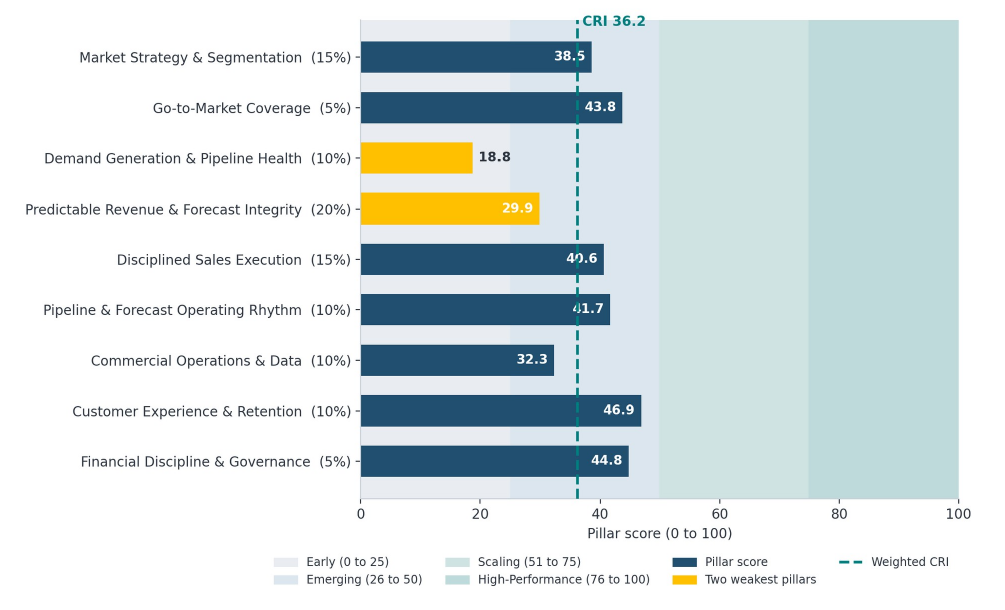
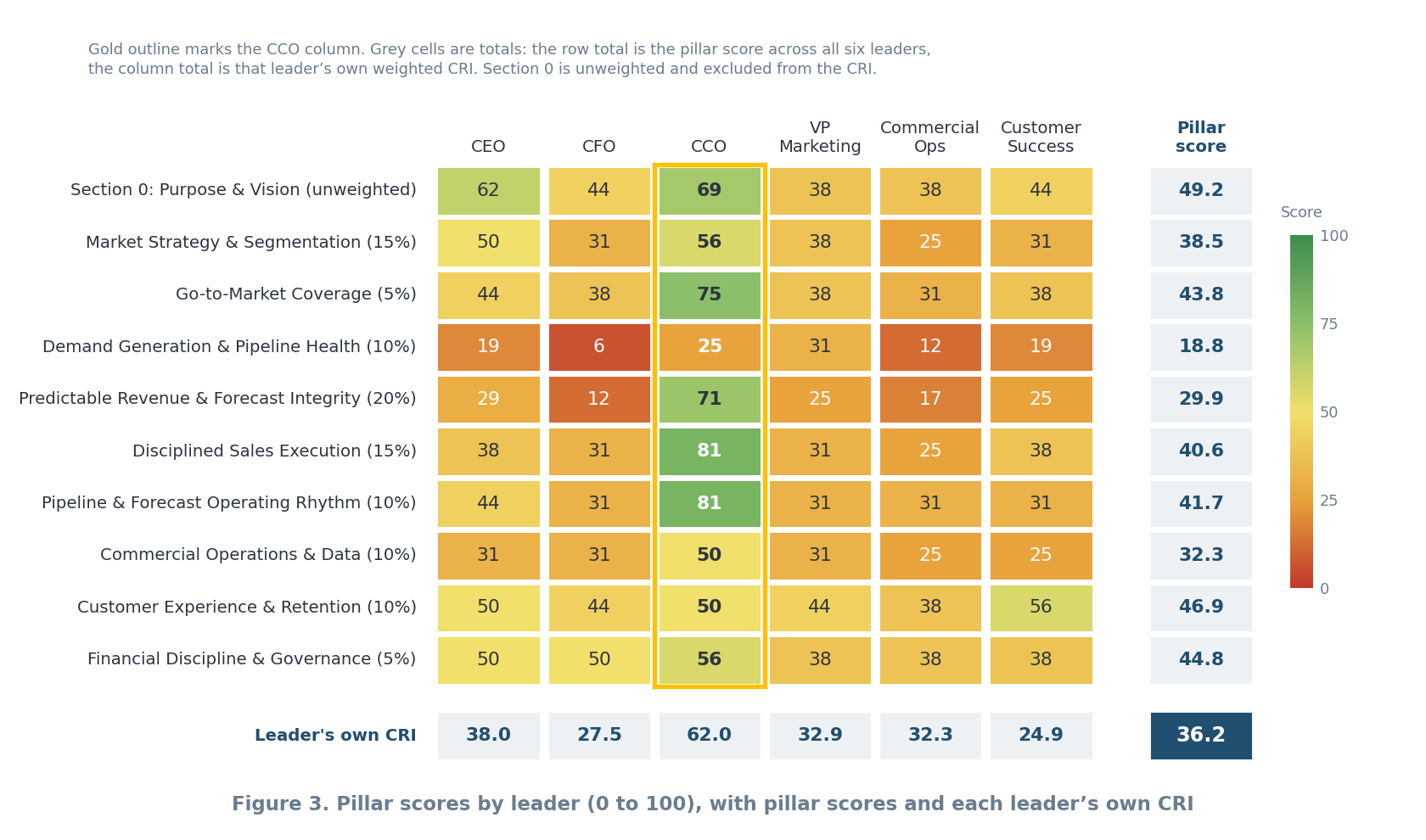
The full report for Larchmere Biosystems, a fictional life science tools company built for this purpose. It runs to 33 pages and covers the six leaders who took part, the score and its band, the nine areas scored and ranked, where the team agrees and where it splits, a 90 day plan with named owners, and an appendix carrying every statement rated by role.
Larchmere sits at $45M in revenue with eight sellers. The same assessment runs in companies from around $5M to $250M, with the weighting set to the business.
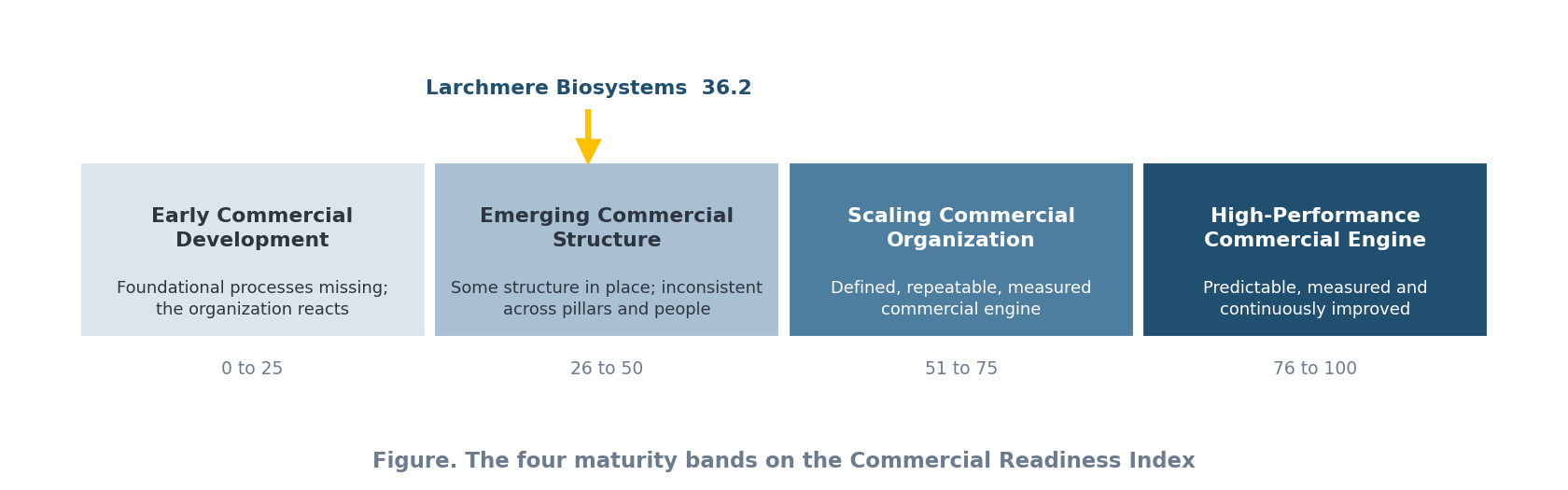
Larchmere scores 36.2 out of 100, which puts it in the Emerging band. The more useful number is the spread underneath it: rate the company through the Chief Commercial Officer's answers alone and it reads 62.0, and through the Commercial Operations Manager's it reads 24.9. Same company, same quarter.
Client assessments are confidential, so Larchmere is a composite, put together from patterns that come up again and again in companies at this stage. The numbers are illustrative. The structure and the output are exactly what a client receives.